Monday, November 10, 2014

The Falling Man and 9/11 History

After watching Objects and Memories, I stumbled upon 9/11: The Falling Man, a documentary made in 2006. It tells the story of the photograph at right, of a man accidentally or intentionally falling from the north tower of the World Trade Center on September 11. The photo ran only one time in many papers on September 12, but created such an uproar it was not published again for several years.

The fact the image is disturbing, and given the misleading impression the man  fall straight down although the series of photos shows the man tumbling, I don't think can be disputed. What I do ask is do public historians have an obligation to document "The Falling Man," by Richard Drew, as well as the others who fell to their deaths on 9/11?

According to reports on the 9/11 Museum, there will be a small alcove which at least acknowledges their existence. The people who fell or jumped deserve to be recognized as well as those who some seem to believe died a more heroic death. Why was accidentally falling or taking one's fate into one's own hands and jumping less heroic that accidentally being crushed by debris or suffocated by toxic smoke?

The photo at left is another famous photo of a person being killed. It has been know variously as "The Falling Soldier" or  "Loyalist Militiaman at the Moment of Death, Cerro Muriano, September 5, 1936" by Robert Capa. The image is of a soldier being killed and yet since he was perceived as a hero, any debate on the publication of this image was limited. Why?

National Archives Releases Clinton Documents

I found an interesting New York Times article regarding the National Archives. About a month ago, it released about 10,000 pages of Clinton administration documents that were previously restricted.

The newly released documents shed light on several different topics including, yes, the Monica Lewinsky scandal, among others. The documents offer a glimpse into behind-the-scenes political dealings that we usually don't get to see, such as "damage control" suggestions for the Clintons when they were involved with an investigation into a real estate transaction in Arkansas known as "Whitewater".

There is also a rather personal note from President Clinton to then-First Lady Hillary Clinton asking her what they should do about the recent suicide of a longtime friend. Documents like that are the most interesting to me since they offer insight into what the president is like as a person, rather than as a political leader. It's easy to forget that even the President of the United States is a human being.

The article doesn't mention why these documents were released when they were, though it's clear why they were restricted in the first place since some of the documents are rather personal. You can view all of the previously restricted Clinton documents on the web site for the President William J. Clinton Library here.

An interesting article related to Objects and Menories

While re-watching Objects and Memories, I noticed a sign in the window of the shop the impromptu 9/11 memorial was preserved. The sign is at the right; it reads "Sr\tore Closing, Everything on Sale, UP TO 50% OFF." The video doesn't mention the store closing so I Goolgled it. I found this article in the New York Times from August 25, 2006. The article is very interesting; it tells the story of very difficult and expensive to preserve artifacts and the lengths went to preserve the artifacts and protect the public who wen to see the exhibit.

The sign is a sad commentary on what happened to the economy of lower Manhattan after 9/11 as well as on 9/11; the video of Mr. Cohen was dated October 22, 2002, and the article states the store closed on October 26, 2002. Maybe the closing of the store wasn't relevant to the documentary, but I feel some mention should have been made.

Thursday, November 6, 2014

Disastrous Sinkhole Becomes the Star of a Museum

When I heard about a massive sinkhole that nearly destroyed eight Corvettes at the National Corvette Museum back in February, I thought that this would surely lead to disaster for the museum.  I recently came across an article in The New York Times addressing this event and, to my surprise, the sinkhole became a star!  Bowling Green, Kentucky experienced a 60-foot-deep sinkhole right under the museum, stunning car lovers at the damage it had done.  Some of the cars were unrecognizable, like the 2011 high-performance Z06, while others were exposed to less damage.  The museum did not expect this to turn out positively, but it did indeed!  The sinkhole became a tourist magnet, shooting attendance up 59 percent in March compared to the same time in 2013.  This spike in attendance lead to growing sales atthe gift shop and cafe as well.

Though this disaster has turned out fairly well for the museum, they felt torn between keeping the financially rewarding sinkhole or filling it in and displaying their prized Corvettes.  After all, the mission of the museum revolves around these cars!  In June, the museum board meet and chose to preserve a small portion of the sinkhole, but not keeping it as a main attraction.  Katie Frassinelli, the museum's marketing and communication manager, praised the sinkhole's occurrence for bringing in publicity, but also called it a novelty that will eventually wear off.  I agree, considering the museum is called the National Corvette Museum and probably would not make it as the National Sinkhole Museum!


Above is a picture of a few of the cars that were removed from the sinkhole.  More photos can be found at the link below.

When the sinkhole occurred, the museum was thankfully closed and empty of visitors.  The museum was built on top of underground caves, which museum officials were not aware of.  Since we've been talking about disaster planning in both our museum and archive class, I thought this was an interesting example of a disaster gone right.  This sinkhole damaged collections, but also brought in a different type of visitor than usual.  The museum used this disaster to their advantage, something I had not yet thought about.

Here's the link the the article:

http://www.nytimes.com/2014/06/27/us/kentucky-sinkhole-a-mixed-blessing-for-corvette-museum.html?_r=0

Wednesday, November 5, 2014

Halloween at the Smithsonian

I know I'm about a week too late, but I was excited to come across an article about Halloween celebrations at the Smithsonian!  The museum offers day and night activities at the museum in D.C. and also provides virtual celebrations for those who cannot attend. "Halloween Changes Its Disguise:  Has the Witching Season Grown Up?" is one of the various activities offered at the Smithsonian on Halloween.  Here, Daniel Gifford, author of American Holiday Postcards, 1905-1915:  Imagery and Context, spoke about how sexy female costumes were popular long before modern women started wearing them.  Halloween postcards showcasing sexy witches were popular in the early 20th century.  He spoke about these postcards and how the holiday has changed and stayed the same over time.  

One virtual Halloween activity that was offered was "Monsters Are Real,"  The Biodiversity Heritage Center explored books, stories, and animals that inspired popular monsters. They updated their Facebook and Twitter pages so fans could follow along with their posts on this topic.  The Smithsonian also provided Day of the Dead virtual celebrations through their Latino Virtual Museum.  Users could join live events via the Latino Centers UStream channel or build their own   3D virtual altars though the avatar based virtual world, Second Life. Sandra Cisneros, author and creator of "A Room of Her Own:  My Mother's Alter,"  honored her mother who only had a room of her own the last 10 years of her life through this exhibit.  The exhibit told her mother's story with a Dia de Muertos theme and runs until the beginning of January.

null

At the museum, the Smithsonian Gardens offered Ghoulish Gardens.  This exhibit displayed creepy, odd-looking plants in celebration of Halloween.  Plants like the Himalayan Balanaphora, similar to a toadstool, and the Tacca chantrieri, with black flowers and long whiskers, were showcased for visitors.  The museum also placed doll's eyes to follow visitors in the Bird Garden.  The museum posted pictures on their Facebook page for fans that could not attend.

null


Here's the link to the article:

http://www.smithsonianmag.com/smithsonian-institution/ghoulish-gigs-galore-all-to-explore-180953153/

I've never thought about attending a museum on Halloween!  I will definitely be watching out for events like this time next year.


Get Moving at the Getty!
Art for the Whole Body

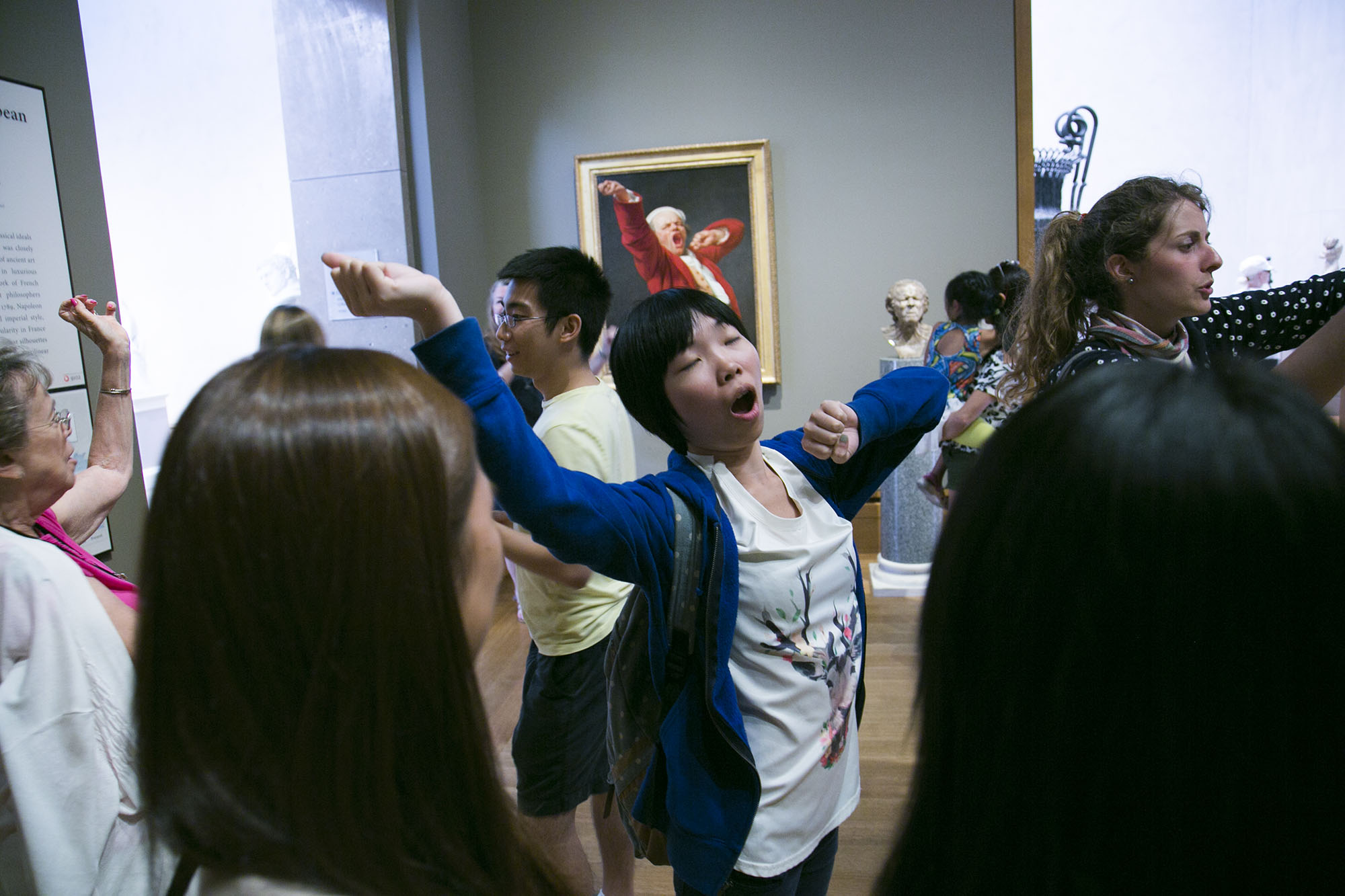
The J. Paul Getty Museum is getting people moving! If you have ever been to an art museum the normal way of viewing art work is by strolling through the galleries, but for some people they need a little bit more than a stroll through Rembrandt's work or more than a few glances at a Roman sculpture. The staff at the Getty are trying to switch up how their visitors are viewing the art work there, so they have started their new Move! tours that are offered every Thursday. Move! tours let visitors have the option of connecting to artwork through movement and feeling. On these tours visitors participate together in imitating figures that are portrayed in paintings and sculptures.
                              Move! participants work together to imitate details in Joseph Ducreux’s Self-Portrait, Yawning. 

The staff at the Getty museum is exploring questions that involve the combination of art and our senses such as what do art objects ask us to do? Can art objects ask us to respond physically? Which of our senses do we privilege or not privilege in the gallery? DH0A5372_editDH0A5366_edit

The Getty offers a new way of interpreting artwork through a more personal understanding. The normal visitor would usually participate in the conventional “museum body language” by walking slowly then stare at a piece of art for about 17 seconds, maybe read or listen to some of the description and then move on to the next piece. Now visitors can interact with the art by imitating what is going on with the pieces, by doing this they can get a better understanding of not only the piece of art itself but the artist too. This is a way for visitors to connect to history by imitating images of historical figures therefore getting an idea of what those figures may have physically felt. Move! also includes imitating furniture too! This interpretation also makes the visit to the museum more memorable and can help visitors remember specific aspects about specific pieces of art that they encountered.
This tour is 45 minutes and includes movement for all ages and ability levels. This kind of tour is also great for people with disabilities. For example visitors who have vision problems or who are blind can get an idea of how a painting or sculpture looks by having someone help them to imitate what is going on in the artwork. I think the Getty has come up with a great way to make exhibits interesting and memorable in a way that anyone can participate in!


Monday, November 3, 2014

Records of Our National Life: American History at the National Archives

While browsing at a local public library, I came across this book. It was published in 2009 to commemorate the 75th anniversary of the National Archives.

The book is set up in chronological order with photographs of mostly two-dimensional objects from the National Archives. It covers everything from the American Revolution to the election of Barack Obama. One of the highlights for me was an image from 1918 of five women holding baskets of fruit stones and nut shells standing next to a large pile of shells and stones with a soldier standing on top of it, the flag in the background. From this, I learned that during World War One, the government encouraged the public to save the pits of prunes, apricots, dates, cherries and peach stones, among others as well as the shells of walnuts, butternuts and hickory nuts for their use in making gas masks for the soldiers at the front.

Also included are photographs of original documents such as George Washington's first inaugural address, written in his hand. The Treaty of Paris is also included, which ended the American Revolutionary War as well as signed Oaths of Allegiance by Marquis de Lafayette, George Washington, Benedict Arnold and Alexander Hamilton. There are hundreds of other photos of original images and documents in the book. As I looked through it, particularly at the images of the founding documents of the United States, it really drove home the value of keeping original records rather than reproductions in another format. Even an exacting reproduction wouldn't be the same. The documents themselves, as much as the words hand-written on them, say something about who we are as a country and where we came from.